How Long Do Water Heaters Last? (+repair vs replace)
A standard tank water heater lasts roughly 8 to 12 years, and a tankless one roughly 15 to 20 years or more, but the exact numbers depend on who you ask. Rheem, a water heater manufacturer, says the average life of a traditional tank model “typically falls between 8 and 12 years,” and This Old House uses the same 8–12 years. A 2009 U.S. Department of Energy fact sheet, still online, puts tankless heaters at “more than 20 years, compared with 10 to 15 years for traditional heaters.” ENERGY STAR suggests you start thinking about replacement once a heater is more than 10 years old.
Lifespan by type: tank, tankless, heat pump
The sources agree on the order (tankless outlasts tank) but not on the exact years, so here they are side by side:
| Source | Tank (storage) | Tankless |
|---|---|---|
| U.S. DOE, Building America fact sheet (2009) | “10 to 15 years” | “more than 20 years” |
| ENERGY STAR (gas tankless page) | — | “a life expectancy of 20 years” |
| Rheem (manufacturer, March 2026) | “between 8 and 12 years” on average | “often ranges from 15 to 20 years or more with proper care” |
| This Old House (June 2026) | “8–12 year lifespan” | “20–year lifespan” |
| Fixr installation guide (January 2026) | “8–12 years” | “15–20 years” |
Fixr’s repair guide (August 2025) gives a shorter figure for water heaters in general: “Most water heaters last around eight to ten years.”
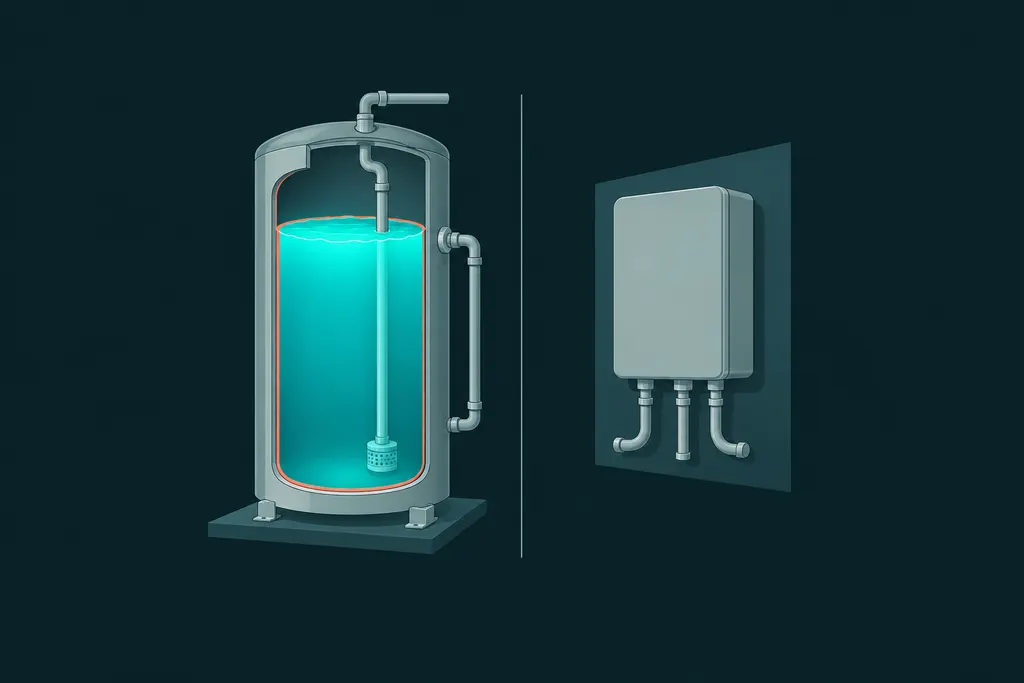
Tank heaters store hot water and keep it heated. Rheem names several factors in how long a tank lasts, including sediment that settles at the bottom of the tank, the anode rods that “help protect the tank lining from corrosion,” and water quality.
Tankless heaters heat water only as it flows. Rheem says well-maintained systems “can reach 25 to 30 years of service.”
Gas vs. electric tanks. None of these sources gives separate lifespans for gas and electric tanks; they group both as tank (storage) heaters.
Heat pump (hybrid) water heaters. This Old House groups heat pump models with tankless and solar units as premium models that “often last twice as long as standard tank units.” ENERGY STAR’s savings table for heat pump water heaters assumes a 13-year lifespan, which is a planning figure, not a promise.
How to find your water heater’s age
ENERGY STAR’s advice: find the brand name and serial number on the tank label. “In some cases, the date of manufacture is printed on the same tank label where the serial number is located.” If it isn’t, ENERGY STAR says to use an online water heater industry resource to decode the serial number. It links to several, including the manufacturers’ own (A. O. Smith, Bradford White and Rheem). Formats vary, so use the guide for your brand, or ask your plumber to read it.
Read the label from the outside. You don’t need to remove any cover or panel to find it.
Signs a water heater is near the end
ENERGY STAR notes that a water heater can “appear to be working fine and then fail without warning,” but most times there are early signs. Its list of red flags:
- Visible corrosion on the tank or around the water lines.
- Water leaking from joints, seals or seams. Fixr adds that water pooling around the base “usually indicates corrosion or a cracked tank.”
- Rust in your water, which ENERGY STAR calls “usually a sign that the interior of the water heating system is corroding.”
- Less hot water than before. ENERGY STAR says aging and poor maintenance can let sediment build up inside the tank “in a way that reduces capacity.”
- Rumbling noises, which ENERGY STAR says can very often be traced to sediment on the bottom of the tank.
This Old House adds needing several repair calls within a year, rising energy bills without a change in use, and temperature swings. If yours is leaking, see water heater leaking from the bottom or leaking from the top; if you have no hot water at all, start with no hot water: what to check.
Repair or replace?
Two rules of thumb show up in the sources:
- Age. ENERGY STAR: “If you suspect your water heater is more than 10 years old—it is time to consider replacing it before you’re left with an emergency decision.” This Old House also says to consider replacement at 10 years.
- Cost. This Old House: “Generally, when repair costs exceed half the price of a new unit, replacement becomes the more economical choice.”
For a newer heater, This Old House says “minor issues in newer units warrant repairs,” and Fixr puts the average water heater repair at $150 to $750. Repair prices by part, replacement prices by type, and a calculator for your own numbers are on our repair or replace water heater calculator page.
What helps a water heater last longer
Your owner’s manual lists the maintenance your model needs. Rheem describes the usual work: annual descaling for tankless units, especially in hard water, and periodic flushing plus an anode rod check for tanks.
Draining, flushing, descaling and anode replacement are work for a licensed plumber. Ask about them at a service visit, and ask the plumber to test the temperature and pressure relief valve too, rather than doing it yourself.
Leaks and safety
A leaking heater needs a licensed plumber. Keep away from water near outlets or appliances, and shut off the water at the main valve only if you can reach it safely. If a gas water heater’s pilot is out or it won’t light, call a licensed plumber. If you smell gas, leave the house and call your gas utility or 911 from outside; the Iowa Utilities Commission also says not to create a spark. Never plug or cap the relief valve.
Not sure where the water comes from?Run the Leak Finder →Sources
- U.S. Department of Energy, Building America — Tankless Water Heaters fact sheet by CARB / Steven Winter Associates (last update Aug 18, 2009; still on a DOE server), p. 1
- ENERGY STAR — Save More with ENERGY STAR Gas Tankless Water Heaters (undated; accessed Oct 31, 2026)
- ENERGY STAR — When Should You Replace Your Water Heater? (Feb 2, 2024)
- Rheem (manufacturer) — Tank vs. Tankless Water Heater Lifespan Comparison: What to Expect Long-Term (Mar 5, 2026)
- This Old House — How Much Does Water Heater Installation Cost? (updated Jun 17, 2026; cost data from The Home Depot and market research)
- Fixr — How Much Does It Cost to Install a Water Heater? (updated Jan 27, 2026)
- Fixr — Water Heater Repair Cost (updated Aug 29, 2025)
- Iowa Utilities Commission — Natural Gas and Propane Gas Safety, Safety Minute (July 2026), p. 5
Checked 2026-10-31
Illustrations on this page are AI-generated to help you picture the situation. They are not photos of real homes, jobs or people.