Water Heater Leaking From the Bottom: What It Means
Water under a water heater comes from one of a few places: condensation, the drain valve near the bottom, the relief valve’s discharge pipe, a leaking connection higher up, or the tank itself. Only a leaking tank, or seepage at the welded fitting the relief valve screws into, means a new heater. A. O. Smith, a water heater maker, says a leak from the base “is often the first indication of a serious problem,” and that a leaking tank should be replaced, not patched. Treat it as urgent: stay clear of water near the heater’s electrical parts, shut off the water if you can reach the valve safely, and have a licensed plumber find the source before anyone quotes a new heater.
What to do right now
- Keep away from water near outlets, cords and the heater’s electrical parts. Don’t stand in water to reach the heater.
- Shut off the water only if you can reach the valve safely. That is the main shutoff, or the shutoff valve on the cold-water pipe going into the heater, which A. O. Smith’s leak guide points to.
- Leave the heater’s gas and power controls to the plumber. If you smell gas, leave the house and call your gas utility or 911 from outside. Washington’s utility regulator says to call “from a safe distance away from the odor.”
- Stop using hot water. A. O. Smith says “you should not continue using a leaking water heater” until it has been checked.
- Catch the drip, move boxes and rugs, and take photos of the heater and any damage for your insurer.
- Call a licensed plumber. A. O. Smith’s FAQ says a leaking water heater “should be treated as urgent.”
Where the water at the bottom comes from
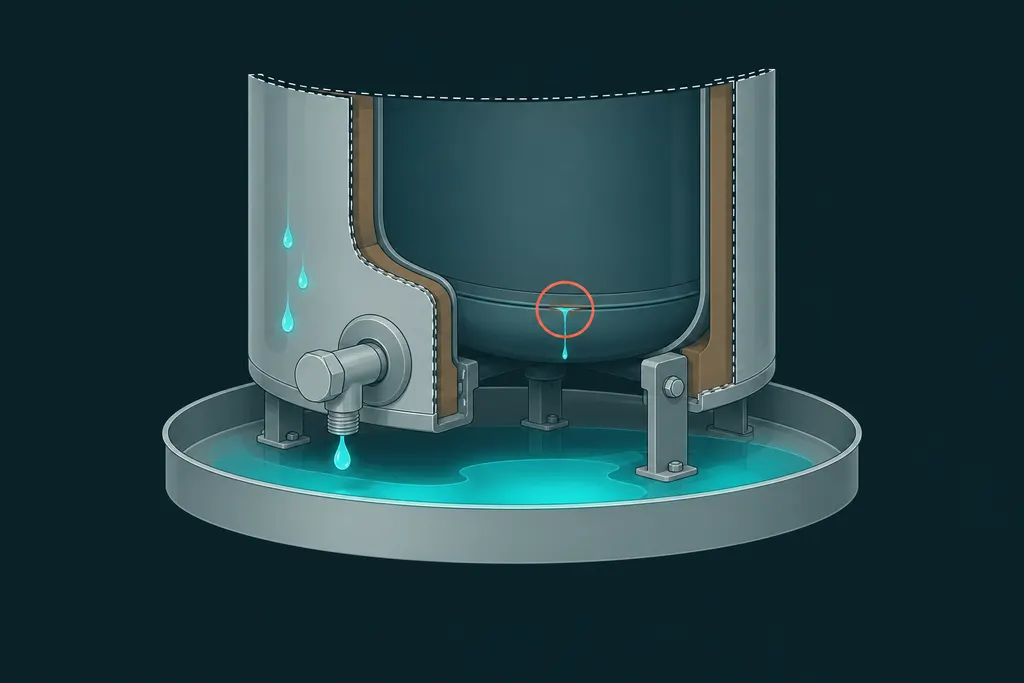
A. O. Smith’s electric water heater manual lists “leakage checkpoints” and warns: “DO NOT replace the water heater until a full inspection of all possible water sources is made.” The places to check:
- Condensation. On a gas heater, water vapor in the flue gases condenses on the cold tank when the burner runs. A. O. Smith says a typical home water heater “will produce about one-half gallon of water vapor during every hour of operation,” and that condensate “is often mistaken for leaking.” It shows up after a long run of hot water or when cold water comes in, and should stop once the whole tank has heated up. Wipe the floor dry; if water keeps collecting while the heater sits hot and unused, it is probably not condensation.
- The drain valve. This is the faucet-like valve near the bottom of the tank. The manual says water from it “may be due to the valve being slightly opened,” or the valve “may be leaking at the tank fitting.” Either way it’s a valve problem, not a tank problem.
- The relief valve and its pipe. The temperature and pressure (T&P) relief valve has a discharge pipe that runs down the side of the heater and must end no more than six inches above a floor drain, or outside. If the valve isn’t piped to an open drain, the manual notes, “the released water could be mistaken for a leaking heater.” See pressure relief valve leaking.
- Connections higher up. The manual says water in the bottom of the heater or on the floor “may be from condensation, loose connections, or the relief valve.” A drip from the top can end up at the base; see water heater leaking from the top. On electric models, A. O. Smith also lists leaks at the heating-element gaskets.
- Something nearby. “Leakage from other appliances, water lines, or ground seepage should also be checked.”
- The tank itself. If none of the above explains it, the tank is the likely source.
When the tank itself is leaking
Tanks don’t last forever. A. O. Smith’s gas heater guide says that “due to the normal corrosive action of the water, the tank will eventually leak after an extended period of time.” Each tank has an anode rod that corrodes in place of the tank; the electric manual says “once the anode rod is depleted, the tank will start to corrode, eventually developing a leak.” Sediment plays a part too. A. O. Smith says a leak from the bottom “could be excess sediment,” and that heated sediment can make the metal “weak and eventually crack and leak.” Rusty or cloudy hot water and rumbling or popping sounds are warning signs it lists.
Once a plumber confirms the tank is leaking, the answer is replacement. A. O. Smith’s bulletins say “the tank should be replaced” and “Leaking heaters cannot be ‘repaired’.” Fixr’s price list includes tank repairs, but the manufacturer’s position is that a leaking tank gets replaced.
Repair or replace?
It depends on which part is leaking. Prices from two guides, each for the work named:
| What’s leaking | Usual fix | Typical price |
|---|---|---|
| Drain valve | Replace the valve | $100–$200 (Fixr, 2025) |
| T&P relief valve | Find the cause; replace the valve if it’s worn | $100–$250 to replace the valve (Fixr, 2025) |
| A connection, or a leak not yet traced | Depends on the leak | $50–$600 for “fixing a leaking water heater,” minor leaks to more serious ones (Fixr, 2025) |
| The tank | Replace the water heater | Tank model, installed: $1,200–$2,300 (This Old House, 2026); $600–$2,500 (Fixr, 2026) |
The two guides use different data; This Old House’s comes from The Home Depot and its own market research. It says to “consider replacement when your unit reaches 10 years old,” and that “when repair costs exceed half the price of a new unit, replacement becomes the more economical choice.” A. O. Smith says water heaters “typically last between 8 and 20 years, depending on the type.” For more on lifespan, see how long water heaters last, or try our repair-or-replace calculator.
Cleaning up water damage
The EPA says to “dry water-damaged areas and items within 24-48 hours to prevent mold growth.” If water soaked into drywall, carpet or wood flooring, ask a water damage cleanup company to dry it out. This Old House lists $500–$2,500 for water damage repair “if a failing unit has caused flooding in your home.”
Before cleanup, photograph the heater, the water and anything damaged. Using a burst pipe as its example, Triple-I says the HO-3 homeowners policy “covers you for accidental discharge of water from a plumbing system.” It also notes that groundwater seeping into a basement is excluded. For a leak from a water heater, especially a slow one, ask your insurer or agent how your policy treats it. Policies vary, so check yours.
What to ask the plumber
- Where exactly is the water coming from? Did you rule out condensation, the drain valve, the relief valve pipe and the connections?
- Is the tank itself leaking, or a part that can be replaced?
- If it’s the relief valve, what’s making it open: pressure, temperature or a worn valve?
- If I need a new heater, what does the price include: removal of the old unit, permit, and anything my city requires?
Not sure the heater is the source? Try our Leak Finder.
Not sure where the water comes from?Run the Leak Finder →Sources
- A. O. Smith — Why Is My Water Heater Leaking? (manufacturer guide, undated; accessed Oct 31, 2026)
- A. O. Smith — Technical Bulletin #51: Puddle on the Floor (undated; accessed Oct 31, 2026)
- A. O. Smith — Technical Bulletin #15: Condensation (undated; accessed Oct 31, 2026)
- A. O. Smith — Residential Electric Water Heaters Instruction Manual, Part No. 185762-002 (2012), p. 15 (anode rod) and p. 19 (Leakage Checkpoints)
- A. O. Smith — Direct Vent Residential Gas Water Heater, Installation Instructions and Use & Care Guide (2013), p. 6 (tank life) and p. 15 (discharge pipe)
- This Old House — How Much Does Water Heater Installation Cost? (updated Jun 17, 2026; cost data from The Home Depot and market research)
- Fixr — Water Heater Repair Cost (updated Aug 29, 2025)
- Fixr — How Much Does It Cost to Install a Water Heater? (updated Jan 27, 2026)
- U.S. EPA — A Brief Guide to Mold, Moisture and Your Home (page last updated Feb 18, 2026)
- Insurance Information Institute (Triple-I) — Am I Covered? (undated; accessed Oct 31, 2026)
- Washington Utilities and Transportation Commission — Pipeline Emergencies (undated; accessed Oct 31, 2026)
Checked 2026-10-31
Illustrations on this page are AI-generated to help you picture the situation. They are not photos of real homes, jobs or people.