How to Find a Water Leak Underground
To find a water leak underground, start with your water meter. The EPA says to check it “before and after a two-hour period when no water is being used. If the meter changes at all, you probably have a leak.” Then close your home’s main shut-off valve and watch the meter again. If it still moves, the leak is probably in the buried line between the meter and the house. Other clues include soggy ground, a strip of greener grass and a rising water bill. A plumber or leak-detection specialist can then narrow down the spot before anyone digs.
Signs of an underground water leak
- A higher water bill with no change in use. The EPA suggests checking a winter month, such as January or February: “If a family of four exceeds 12,000 gallons per month, there could be serious leaks.”
- Soft or soggy ground. Austin Water: “Soft or soggy areas in your yard or uneven plant growth may indicate a leak in underground pipes.”
- A strip of greener grass along the line’s path, which Fixr links to water leaking into the soil.
- Standing water, puddles or small depressions. San Francisco’s utility says a major service-line leak “may cause standing water or ponding,” which “may look like a broken irrigation pipe.” Fixr mentions puddles or depressions filled with water.
- Standing water around the foundation, which Austin Water says “could mean underground pipes are damaged.”
- A drop in water pressure, which Fixr says you should notice if the issue gets worse.
If your house sits on a concrete slab and the clues are inside, such as a warm or damp spot on the floor, read slab leak signs, causes and what to do.
The water meter test
The meter only runs when water flows into your property, which is why Denver Water says it “may be your most useful tool” for finding hidden leaks. The EPA says it is “usually near the curb in front of your home,” or inside in cold climates.
- Stop all water use, including the dishwasher, washer and irrigation.
- Read the meter. Note the numbers and the sweep hand. Denver Water says most meters also have “a small, red triangle or gear-shaped indicator that will show very small water flows.”
- Wait, then read it again. The EPA’s checklist says: “If the meter does not read exactly the same after two hours, you probably have a leak.” Denver Water uses 30 minutes or more.
- If it moved, close the main shut-off valve where the water line enters the house, if you can reach it safely. The Smart Home Water Guide says to turn shut-off valves by hand only, and notes that some lines, such as irrigation or pool supplies, can bypass the house valve; if yours do, their valves need to be off too. Denver Water: “If the indicator stops, your leak is inside the building,” and toilets are “the most common leak culprit.” “If the indicator continues to move when the shut-off valve is closed, you have an underground leak between the water meter and the shut-off valve.”
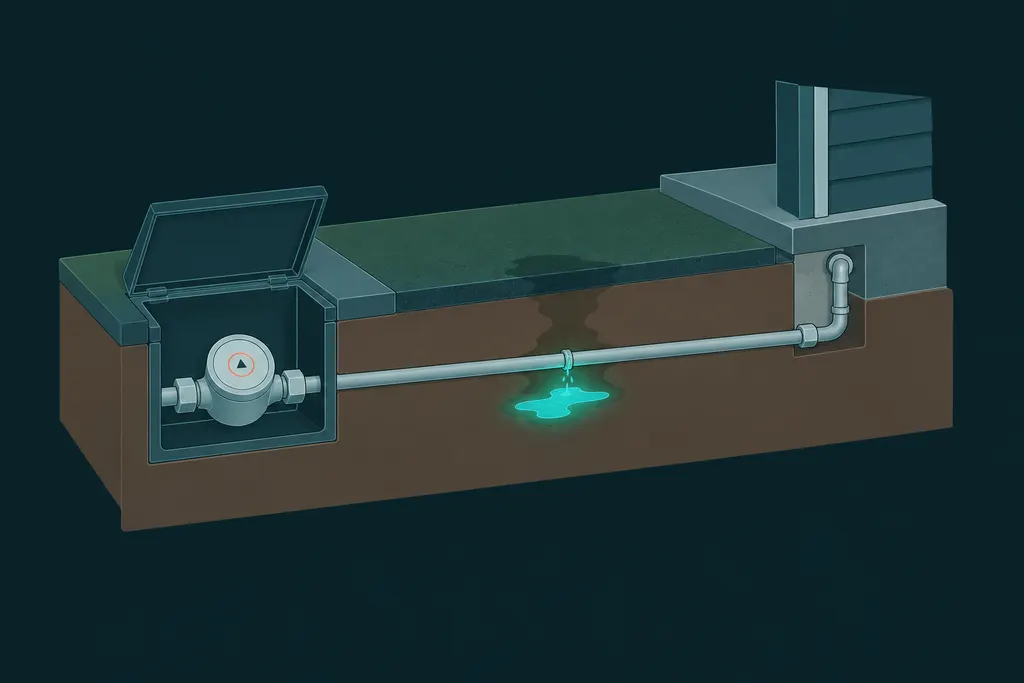
Don’t turn off the water at the meter itself: the Smart Home Water Guide says the line must stay full and pressurized for the test, and to ask your water provider if the meter needs shutting off. Some utilities don’t want customers opening the meter box at all; San Francisco’s says “please do not access water meters” and offers a site visit instead. Check your utility’s website first.
Your side or the utility’s side of the line
Who pays for the repair depends on where the leak is and on your utility’s rules, which differ:
| Utility | Where the owner’s part starts |
|---|---|
| Austin Water | “Property owners are responsible for service lines past the meter.” |
| San Francisco PUC | The service line “begins at the water meter,” and “it is your responsibility to find and fix leaks on your property.” |
| Denver Water | Property owners are responsible for “the service lines and meter pits at their service address,” starting “where the property taps into the main.” |
Austin Water’s diagram shows the public-side line from the street to the meter as the part it owns and maintains, while in Denver the whole service line belongs to the owner. Check your utility’s website for its rule and how to report a leak on its side, and ask whether it offers a leak bill adjustment, as Austin Water and Denver Water do.
How pros pinpoint an underground leak
San Francisco’s utility tells customers to contact “your local plumber or a leak detection specialist to locate and repair the leak.” Fixr’s slab leak guide describes the basic visit: the plumber tests water pressure, looks for signs of moisture and checks the landscaping for excess water.
A leak-detection handbook for water utilities by Stuart Hamilton and Bambos Charalambous (IWA Publishing, 2020) describes several tools. Two that work along a buried line:
- Listening. “Water escaping through a leak creates a noise.” A ground microphone is moved along the surface above the pipe’s path until the sound is loudest. The handbook notes that plastic pipes carry leak sound less well, so the noise gets “weaker and weaker” with distance.
- Tracer gas. A gas, most commonly hydrogen “typically diluted 5% in nitrogen,” is fed into the pipe. “The gas comes to the surface after leaving the leak,” where a detector picks it up.
Ask the plumber which method they plan to use on your line and why, especially if the line is plastic. Fixr notes that some slab leaks also mean drilling holes or clearing soil by the foundation.
Repair options and cost
Fixr says the line “can sometimes be repaired rather than replaced.” Prices from two guides:
| Work | This Old House (April 2026, HomeAdvisor data) | Fixr |
|---|---|---|
| Finding the leak (slab leak figures; neither guide prices a yard line) | $150–$600 | $100–$400 (May 2025) |
| Repairing the water line | $300–$1,400 (waterline repair) | $500–$2,000 (main line repair, August 2025) |
| Replacing the main water line | — | $1,500–$12,000 (page updated August 2025; its title still says 2023) |
Fixr says most homeowners pay around $3,750 to replace a 25-foot main line with galvanized steel using a trenchless method. It puts trenchless replacement at $75–$150 per foot and digging a trench at $175–$225 per foot, before lawn or sidewalk repair. For slab work, see slab leak repair cost and slab leak detection cost.
San Francisco’s guide says “only licensed professionals should make repairs to the water service line.” Before anyone digs, call 811. Call 811 says to contact 811 or your state 811 center “a few business days before you begin any digging,” because some utility lines “can be buried just inches below the surface.”
On insurance, Denver Water says water damage “may or may not be covered” by a typical homeowner’s policy and to ask your insurance agent. Policies vary; see also is a slab leak covered by insurance.
When to call right away
Call a licensed plumber promptly if water is pooling in the yard or around the foundation, the ground is sinking, your pressure has dropped, or the meter keeps moving with the main valve closed. Report leaks on the utility’s side to your water utility. Keep away from water near outlets or appliances, and shut off the water at the main valve only if you can reach it safely. If you’re not sure where to start, try our Leak Finder.
Not sure where the water comes from?Run the Leak Finder →Sources
- U.S. EPA WaterSense — Fix a Leak Week (page last updated Mar 13, 2026)
- U.S. EPA WaterSense — Detect and Chase Down Leaks at Home checklist (PDF, 2017), p. 1
- Denver Water — Leaks (undated; accessed Oct 31, 2026)
- Denver Water — Homeowner Responsibility (undated; accessed Oct 31, 2026)
- City of Austin, Austin Water — Water Leaks (undated; accessed Oct 31, 2026)
- San Francisco Public Utilities Commission — Leak Guide: Finding and Fixing Leaks at Home (PDF, printed Dec 2024), pp. 9–10
- Smart Home Water Guide, Arizona Municipal Water Users Association — Isolation Method for Continuous Leaks (undated; accessed Oct 31, 2026)
- Fixr — Main Water Line Installation Cost (updated Aug 29, 2025; the page title still says 2023)
- This Old House — How Much Does Slab Leak Repair Cost? (updated Apr 7, 2026; HomeAdvisor data)
- Fixr — Slab Leak Repair Cost (updated May 1, 2025)
- Stuart Hamilton & Bambos Charalambous — Leak Detection: Technology and Implementation, 2nd ed. (IWA Publishing, 2020; open access, DOI 10.2166/9781789060850; copy hosted by the Indiana Finance Authority), pp. 10, 13, 42
- Call 811, Common Ground Alliance — 811 Before You Dig (accessed Oct 31, 2026)
Checked 2026-10-31
Illustrations on this page are AI-generated to help you picture the situation. They are not photos of real homes, jobs or people.