Tree Roots in Sewer Line: Signs, Causes and Fixes
Tree roots get into a sewer line through cracks, gaps and loose joints. Seattle Public Utilities calls roots “a common problem” in the pipes that connect homes to the public sewer, and says older concrete and clay pipes “that were not constructed with watertight joints are especially at risk.” Common signs include several drains clogging or gurgling at once and backups that keep coming back. A plumber confirms roots with a sewer camera, clears them by cutting or hydro jetting (This Old House lists tree root removal at $80–$1,000; Fixr at $100–$600), and if the pipe itself is failing, recommends lining or replacing that section.
Signs of tree roots in your sewer line
- Several drains at once. This Old House says a blockage in the main sewer line is “the likely culprit” when multiple drains in the home are clogged.
- Gurgling toilets. Strange gurgling sounds from toilets can mean severe blockages in the sewer line, This Old House adds.
- Foliage in the toilet. Fixr says that if you see pieces of foliage or debris in the toilet when flushing or when it backs up, “you could have an issue with your sewer line and tree roots.”
- Water in the shower when you flush. Fixr calls this a sign of a main sewer line issue; roots are one possible cause, not the only one.
- Clogs that return. Multiple or recurring problems throughout the home “often point to a failing sewer line,” This Old House says.
How urgent is it? A single clogged drain “may not indicate a major issue,” This Old House says. Sewage coming up a floor drain, tub or toilet is different: call a licensed plumber, keep away from the water, and stop using water in the house. During a backup, Seattle Public Utilities advises avoiding flushing toilets or using other water appliances. Our Leak Finder helps sort a sewer problem from a supply leak.
How roots get into sewer pipes
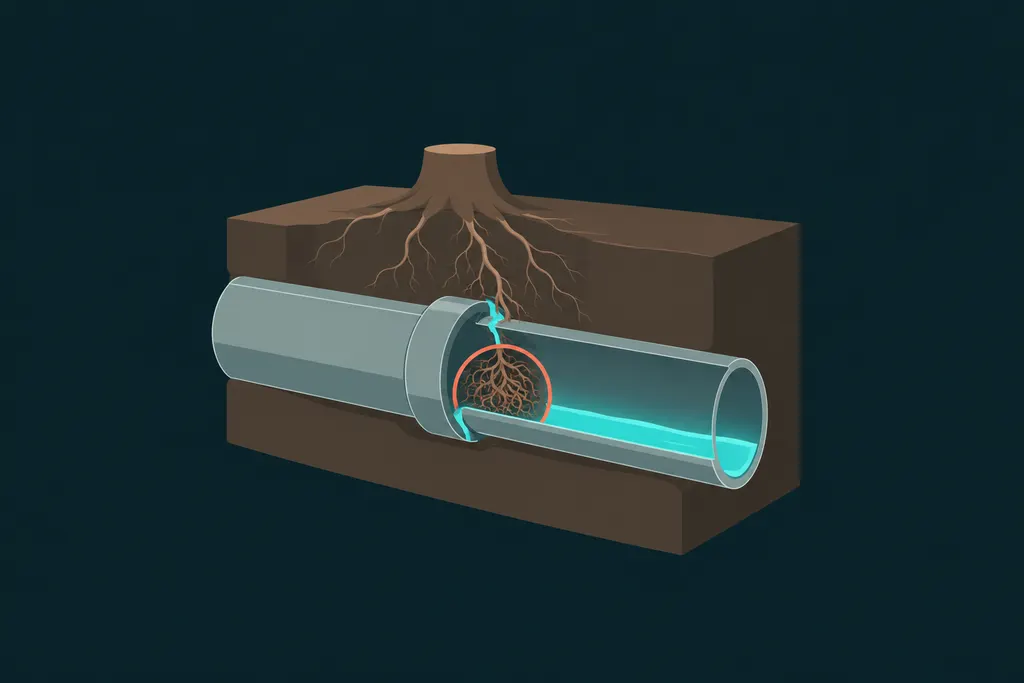
Roots grow toward what a sewer pipe carries. A University of Tennessee Extension publication (2005) says roots invade sewer lines because the pipes contain “water, nutrients and oxygen.” Seattle Public Utilities says roots “are attracted to water and nutrients in the sewer, and can crack pipes and cause sewer backups.”
Sources disagree on whether roots can break a sound pipe:
| Source | What it says |
|---|---|
| N.C. Cooperative Extension (2023) | “Tree roots cannot create cracks in your sewer pipe - they can only exploit existing cracks or gaps.” A root problem means the pipe was already leaking. |
| This Old House (2026) | Roots are attracted to sewer lines “particularly when there is already a small leak,” then “begin to wrap around and break into pipes.” |
| HomeGuide, camera inspection guide (2025) | Roots “push through hairline cracks” and “eventually grow large enough to fill or crush a pipe.” |
N.C. Cooperative Extension and HomeGuide describe roots entering through an existing crack; This Old House says roots are drawn to sewer lines “particularly” when there is already a leak. Pipe material matters too. This Old House says clay pipes, typically found in older homes, “are the most susceptible,” and HomeGuide says tree root infiltration “is common in older cast-iron and clay sewer lines but occurs less often in newer PVC pipes.”
How plumbers confirm the problem
A plumber runs a camera on a flexible cable through the line to look for roots, cracks and other damage; HomeGuide notes that a transmitter in the camera lets the plumber pinpoint the spot from above ground. Seattle Public Utilities notes that a camera can’t see through standing water, so if the line is blocked and not draining, the camera is most useful after the blockage has been cleared. Ask for a copy of the video and the footage where roots were found. See sewer camera inspection cost for prices and what the report should show.
Clearing roots and what it costs
Root clearing is work for a plumber or a sewer cleaning service, not a weekend project. Fixr describes cutting roots with rods or with an auger that has a rotating cutting head, and HomeGuide says hydro jets, which use high-pressure water, “clear major clogs and tree roots.” Seattle Public Utilities cautions that “high-pressure cleaning tools can damage pipes further,” so ask whether the pipe’s condition has been checked first. N.C. Cooperative Extension warns that highly caustic drain cleaner products “can damage older sewer pipes.”
| Work | This Old House (2026) | Fixr (2025) | HomeGuide (2025) |
|---|---|---|---|
| Tree root removal | $80–$1,000 | $100–$600, plus pipe replacement if needed | — |
| Rodding a sewer line | — | $150–$600 | — |
| Snaking the main line | — | $100–$500 | $200–$500 in the text; $150–$500 in its table |
| Hydro jetting | — | $350–$600 | $600–$1,400 in the text; $250–$800 in its table |
In Seattle, no city permit is required for routine cleaning of a side sewer, and the city’s homeowner guide says cleaning “generally” costs less than $1,500.
Cutting roots clears the pipe but doesn’t seal the gap they came through. The Insurance Information Institute says that with continuing root problems, “you may have to regularly have the roots cut by a professional.”
Long-term fixes: lining or replacement
If the pipe keeps letting roots in, the fix is the pipe itself:
- Cured-in-place pipe (CIPP) lining. Seattle Public Utilities says a lining “results in a seamless length of pipe that can prevent roots from infiltrating.”
- Spot repair. Seattle lists it for a defect at one location, including “roots that can’t be removed by another method”; a hole is dug to replace that section.
- Replacement. The Insurance Information Institute suggests replacing the line with new plastic pipe, and This Old House’s Richard Trethewey recommends replacing clay sewer lines in older homes with modern piping.
Compare costs in trenchless sewer repair cost and sewer line repair cost.
Who is responsible for the roots
That depends on your city. In Seattle, property owners are responsible for maintaining and repairing their side sewer, which “includes removing roots up to and within the connection to the sewer mainline.” For trees in the public right-of-way, Seattle says the owner of a tree is generally responsible for the tree’s maintenance, and points owners to the City’s damage-claim process; removing roots from your side sewer is still the property owner’s job. Check your own city or sewer utility’s rules before you pay for work near the street.
Keeping roots from coming back
- Inspect on a schedule. Seattle Public Utilities recommends a camera inspection at least every 8–10 years, and at least every 2–3 years when large trees or shrubs grow near the line.
- Don’t count on cutting the tree down. Seattle says a tree’s roots “will grow up to two times the length of the tree’s height,” so “removing trees above or near side sewers will not likely fix a root problem,” and it advises keeping established trees.
- Plan new planting. The University of Tennessee publication (2005) says “there are no ‘sewer-safe’ trees,” recommends small, slow-growing ones, and says trees “should be located more than 10 feet from sewer lines.” N.C. Cooperative Extension (2023) disagrees that distance helps much: roots can grow two to three times as wide as the tree is tall, so planting five feet closer or farther “won’t make a difference”; it keeps trees off the line so they don’t have to be cut down for sewer work.
- Contact 811 before you dig, even to plant a tree. The national before-you-dig service asks you to contact 811 “a few business days before you begin any digging.”
Sources
- Seattle Public Utilities — Side Sewer Defects & Issues (accessed Oct 31, 2026)
- Seattle Public Utilities — Side Sewer Repair Methods (accessed Oct 31, 2026)
- Seattle Public Utilities — Side Sewer Backups (accessed Oct 31, 2026)
- Seattle Public Utilities — Taking Care of Your Sewer Pipe (PDF, undated; p. 2)
- Seattle Public Utilities — Troubleshooting Your Sewer Problem (PDF, undated; p. 4)
- N.C. Cooperative Extension, Union County Center — Tree Roots & Sewers (Mar 7, 2023)
- University of Tennessee Extension — Choosing "Sewer-Safer" Trees, SP628 (2005; PDF via UT MTAS, p. 2)
- This Old House — Sewer Line Repair and Replacement (updated Apr 10, 2026)
- This Old House — How Much Does Sewer Line Replacement Cost? (updated Mar 30, 2026; cost data from Angi)
- Fixr — Cost to Unclog Main Sewer Line (updated Jan 31, 2025)
- HomeGuide — How Much Does Sewer Line Replacement Cost? (Dec 22, 2025)
- HomeGuide — How Much Does a Sewer Camera Inspection Cost? (Dec 19, 2025)
- Insurance Information Institute (Triple-I) — Protect your house from sewer backups (undated; accessed Oct 31, 2026)
- Common Ground Alliance — 811 Before You Dig (accessed Oct 31, 2026)
Checked 2026-10-31
Illustrations on this page are AI-generated to help you picture the situation. They are not photos of real homes, jobs or people.